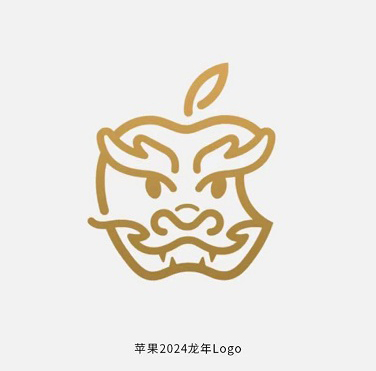
On January 15, Apple revealed its special logo design for the Year of the Dragon. Staying true to its annual tradition, the design cleverly incorporates the Chinese zodiac into the Apple logo, showcasing the dragon’s power and majesty.
According to Apple, the 2024 theme features a majestic Chinese dragon outlined in white, soaring against a golden background. The dragon’s winding body is creatively formed by a long sequence of MacBooks, iPads, and iPhones, with its tail composed of AirPods. Surrounded by auspicious clouds, bursting fireworks, and twinkling stars, the visual embodies the festive spirit and good fortune of the Lunar New Year.
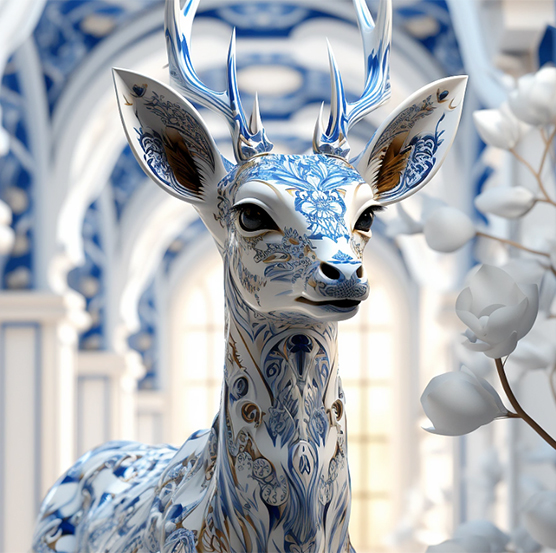
In recent years, with the rapid advancement of artificial intelligence technology, the field of artistic creativity has been undergoing a dramatic transformation. The emergence of tools like ChatGPT, Midjourney, and Stable Diffusion has significantly lowered the barriers to creation, allowing more and more people to experiment with AI-driven art. These works not only showcase unique ideas and expressive forms, but also challenge and expand the traditional boundaries of art.
China: AI-Generated Art Goes “Limitless”
At the exhibition Apex: Beyond the Limitless in New York, USA, Chinese artist Chen Tianchan presented his work Limitless, which uses a continuous spatial lens to depict the vastness of the universe and the infinite variety of the world.
The concepts of large and small, simple and complex, are all relative. It is nearly impossible to reach the end when we explore from any extreme point. As Buddha once said, our world is just a grain of sand in the vast universe. In reality, while basking in the warm sunlight on a beach in California, a single grain of sand beside us might hold an entire world or even a universe of its own.
China: AI-Painted, Growing GUCCI Dreamscape
GUCCI commissioned Random Studio to design the interior of a flagship store in Chengdu, China.
Drawing inspiration from the store’s classical architecture, the Renaissance heritage of GUCCI’s hometown Florence, and the natural elements of Chengdu itself, the immersive, AI-generated landscape explores and expands the use of screens as architectural material.
A monumental digital mural stretches across 33 large LED screens, covering the walls of GUCCI’s three-story flagship store in Sichuan province. Layered with AI-generated imagery, the mural forms an ever-changing fantasy landscape.
The installation perfectly reflects the essence of GUCCI—immersed in a rich historical legacy, yet always looking toward the future.
The visuals shift in a continuous loop throughout the morning, afternoon, and evening, turning the once-static architecture into an immersive, animated space. With each visit at a different time, the atmosphere transforms—never exactly the same.
This vibrant digital mural offers a lasting impression to visitors. No matter when they enter, every fleeting moment is filled with intricate details, just like a living landscape.
Created in collaboration with AI image generators including Midjourney, Stable Diffusion, and DALL·E 2, the mural blends imagery of Chinese hibiscus, Florentine architecture, and ephemeral elements from nature. It explores a new kind of digital aesthetic—one that transcends the present to connect with the past, tradition, locality, culture, and painterly styles.
The AI first generates both static and animated visuals, which are then hand-animated and enhanced with traditional animation techniques. The team dedicated extensive time to refining the AI, improving areas like research, architectural layouts, and curation to ensure accuracy. In this generative process, they carefully balanced human artistic direction with the unpredictability of algorithmic creation.
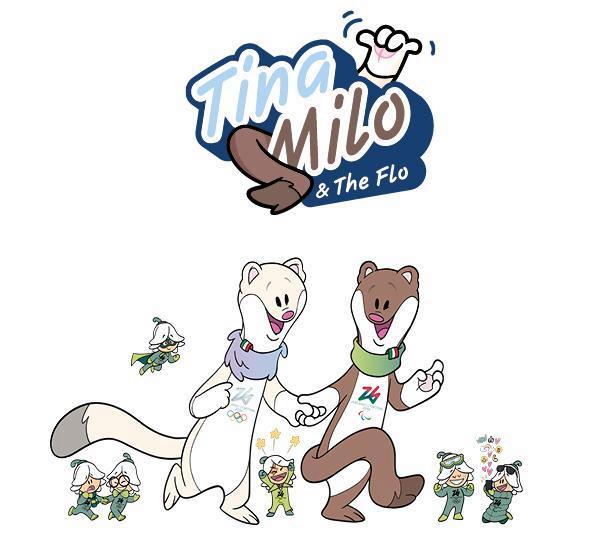
On February 8, the Milan-Cortina 2026 Winter Olympic and Paralympic Games officially unveiled their new mascots: Tina and Milo—a pair of twin weasels.
Tina, the white weasel, is the mascot of the Winter Olympics. Milo, the brown weasel, represents the Winter Paralympics. Tina symbolizes Cortina, and Milo stands for Milan. Their names, “Tina-Cortina” and “Milo-Milano,” are simple, memorable, and rooted in local Italian culture.
The mascots were selected through a national competition that encouraged elementary and middle school students across Italy to submit design proposals. Out of more than 1,600 entries, two finalists were chosen—a pair of weasels and a snowdrop design. The twin weasels ultimately won.
Tina enjoys performances and concerts. Her motto is “Dream big.” Milo is a dreamer and prankster who loves snow and even crafts his own instruments. His motto is “Obstacles are trampolines.”
In response to questions from Xinhua News Agency, the Milan Organizing Committee emphasized that while Tina and Milo are not defined by gender, their personalities are complementary and unique. Their colors—white and brown—also carry symbolism: weasels turn white in winter and brown in summer. These colors represent the importance of nature, reminding us to protect and cherish the environment year-round.
The mascots reflect the Games’ core values of diversity, collaboration, and unity. Milan 2026 is expected to feature 47 percent female athletes, marking one of the most gender-balanced Winter Games in history.
Looking back at past Olympic mascots—from Beijing 2022’s Bing Dwen Dwen and Shuey Rhon Rhon to Tokyo 2020’s robotic duo, and even as far back as the sibling mascots of the 1988 Calgary Winter Olympics—we see a tradition of mascots rooted in culture, storytelling, and charm.
Whether animal, symbolic, or fantastical, these mascots are more than just figures. They carry meaning, spread joy, and remind us of the universal human spirit shared across the world.