Category: Social Connection

On November 14, 2024, our school officially signed an agreement and unveiled the Industry-Education Integration Digital Intelligent Manufacturing Technology Center, jointly established with the Shanghai Innovation and Creation Center of the China Academy of Information and Communications Technology (CAICT). This collaboration aims to thoroughly implement the spirit of the 20th Central Committee’s Third Plenary Session, deepen industry-education integration, and promote the combination of vocational education with industrial practices to meet the demand for high-end technical and skilled talent in intelligent manufacturing and digital transformation.

The event was attended by Ma Jianchao, Director of the Vocational Education Division of the Shanghai Municipal Education Commission, Zheng Zhongbin, General Manager of CAICT’s Shanghai Innovation and Creation Center, Deputy Chief Engineers Qin Feng and Xu Dong, Yu Liping, General Manager of the Digital Industry Division, Zhou Sheng, Party Secretary of the school, Han Fang, Deputy Party Secretary and President, as well as Vice Presidents Yang Yiming and Zeng Xiping. Other relevant department heads from various organizations were also present.

Ma Jianchao expressed high recognition for the collaboration. He emphasized that by deepening industry-education integration, the school can better adjust and optimize its curriculum to meet the industry’s demand for high-quality technical talent. He particularly pointed out that the development of vocational education today relies on industry support. Enterprises should not only provide internship opportunities but also actively participate in the educational process, such as co-developing course standards that align with job requirements.

Looking ahead, Ma Jianchao set higher expectations for the collaboration. He hopes that through the partnership with the CAICT Innovation and Creation Center, resource sharing and coordination can be further strengthened, offering students more internship and training opportunities, especially in real corporate production environments. This will enable students to seamlessly transition into the workforce upon graduation, enhance their competitiveness, and contribute to the development of the intelligent manufacturing industry in Shanghai and across China.

In his speech, Zheng Zhongbin emphasized that this collaboration is not only a crucial initiative to deepen industry-education integration but also a key step in advancing intelligent manufacturing and digital transformation. He stated that the CAICT Innovation and Creation Center is committed to aligning industry demands with school resources, providing students with practical courses and training opportunities to cultivate high-quality technical talent. Moving forward, both parties will continue to collaborate deeply in curriculum design and technological research to drive progress in education and industry.

Zhou Sheng provided a comprehensive overview of the collaboration project, elaborating on the advantages of the school-enterprise partnership and its future development. He highlighted that industry-education collaboration plays a crucial role in promoting vocational education and industrial development. He also expressed hope that this platform would cultivate more high-quality technical talent with practical skills and innovative thinking.

During the signing session, Han Fang and Zheng Zhongbin signed the cooperation agreement on behalf of the school and enterprise, marking the official establishment of the Industry-Education Integration Digital Intelligent Manufacturing Technology Center.

Following the signing, Ma Jianchao and Zheng Zhongbin jointly unveiled the center, symbolizing the official commencement of operations. Moving forward, both parties will leverage the center as a platform to fully utilize their respective resources and technological strengths, driving talent cultivation and technological innovation in the field of intelligent manufacturing.

Han Fang also presented appointment certificates to a group of experts from CAICT’s Shanghai Innovation and Creation Center, naming them Industry Professors and Industry Mentors of the Industry-Education Integration Digital Intelligent Manufacturing Technology Center. This further strengthened faculty resources and technical support between the school and enterprise.

During the event, attendees visited the laboratories of CAICT’s Shanghai Innovation and Creation Center, where they gained firsthand insights into the center’s advanced testing and certification technologies in wireless communications, intelligent connected vehicles, software, and information security. The on-site explanations provided a clearer understanding of how the laboratory’s equipment is applied in education and industry, laying a solid foundation for future in-depth collaboration in intelligent manufacturing and digital transformation.

Established on June 18 this year, the Shanghai International Auto City Industry-Education Alliance is anchored in the Shanghai International Auto City park. It was jointly initiated by Shanghai College of Science and Technology and Shanghai International Auto City (Group) Co., Ltd., making it one of the first municipal-level industry-education alliances in Shanghai. Currently, it has 235 member units, including eight government departments (such as the Jiading District Development and Reform Commission, Education Bureau, and Human Resources and Social Security Bureau), 14 vocational and undergraduate institutions, 211 key industry enterprises, and two research institutions.

Following national policies, including the New Energy Vehicle Development Plan (2021-2035), Intelligent Vehicle Development Strategy, and Jiading District’s “New Four Modernizations” Automotive Industry Action Plan (2021-2025), the alliance—led by the Jiading Automotive Talent Research Association and Shanghai College of Science and Technology—focuses on aligning with Jiading’s trillion-yuan “New Four Modernizations” automotive industry and economic development. Key initiatives include surveying talent supply and demand trends in the automotive sector, mapping key enterprises and talent needs in intelligent connected vehicle (ICV) components, and analyzing the top 40 talents in the ICV sector. Through interviews, visits, and reports, the alliance collects members’ talent and technical needs and shares industry policies and market trends via official WeChat groups and public accounts. The goal is to establish a dynamic collaboration mechanism between academic programs and industry needs, enhancing the automotive talent training system. Notably, six specialized professional clusters within the alliance—including Intelligent Connected Vehicle Technology, Intelligent Control Technology, IoT Applications, Software Technology, Digital Media Technology, and Intelligent Manufacturing Engineering Technology—have been recognized as part of Shanghai’s new round of high-level professional clusters.

The alliance actively promotes collaboration among government, industries, schools, enterprises, and research institutions in talent development, resource building, and technological research. It integrates real-world industry scenarios, new technologies, processes, standards, and equipment into education. Key achievements include:

  • Developing five training programs for intelligent connected vehicle technology and new energy vehicle testing & maintenance.
  • Creating seven specialized courses such as “Chassis Control Technology for Intelligent Connected Vehicles”.
  • Establishing two professional resource libraries for intelligent connected vehicle technology and intelligent control technology.
  • Developing five virtual simulation teaching resources, including “NIO Virtual Disassembly & Digital Resource System” and “NIO Virtual Fault Diagnosis & Digital Resource System”.
  • Organizing major events such as the Shanghai “China Cup” Intelligent Connected Vehicle Technology Competition and the Intelligent New Energy Vehicle Professional Development Forum.
Industry Collaboration and Practical Training

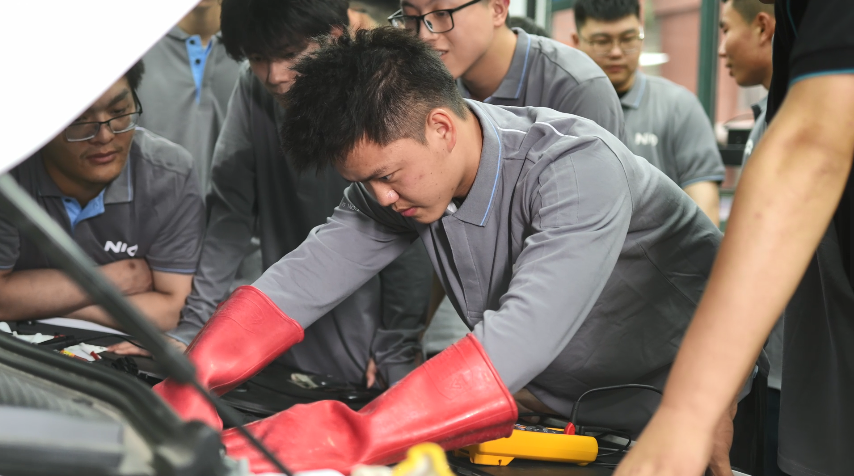
Keeping pace with industry developments, the alliance has partnered with Shanghai NIO and member schools to implement the modern apprenticeship system and establish NIO Technician Training Programs, providing students with job opportunities. It has also collaborated with Shanghai College of Science and Technology to create the Shanghai Open Regional Industry-Education Integration Practice Center – NIO New Energy Vehicle Industry-Education Integration Production Practice Center. This initiative, supported by a ¥15 million investment from NIO and ¥7 million from the school, focuses on developing:

  • NIO Skills Training Center
  • NIO Technology Experience Center
  • NIO Third-Generation Battery Swap Station

Adopting an open, collaborative operational model, the center serves alliance schools and regional vocational institutions, developing:

  • Smart Virtual Simulation Training Center for New Energy Vehicles
  • Course Development & Experiment Center
  • Open Training Center for New Energy Vehicle After-Sales Maintenance
  • School-Enterprise Collaborative Innovation Platform

Through these platforms, the alliance organizes internships, training programs, skills competitions, and government/industry-led vocational training while supporting process improvements and technology R&D.

Future Outlook

Moving forward, the alliance will leverage Shanghai International Auto City’s resources to focus on three core objectives:

  • Deepening industry-education integration
  • Promoting collaboration between vocational and general education
  • Exploring synergies between science, education, and industry

By strengthening long-term cooperation mechanisms between government, industries, schools, enterprises, and research institutions, the alliance aims to innovate industry-education collaboration, create a resource-sharing ecosystem, and drive industry and regional economic growth, ultimately contributing to the high-quality development of China’s automotive sector.